Boulder Jewish News Arts, Culture, Events, Lifestyles, Holidays, Synagogues, Education

JERUSALEM, Israel – September 11, 2025
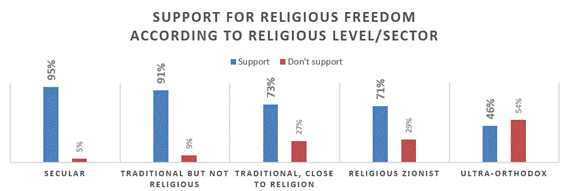
A newly published survey has found that 83% of Israel’s Jewish adult public supports ensuring freedom of religion – namely, the freedom for both secular and religious citizens to live according to their own worldview. The annual Religion and State Index, carried out by the Rafi Smith Polling Institute on behalf of Hiddush, an organization advocating for religious freedom and equality in Israel, found that support for religious freedom is broad: 95% among secular Jews and nearly half (46%) of ultra-Orthodox Jews. Among ‘National Religious’ Jews, 71% support this principle: 79% of liberal religious, 66% of classical religious, and 60% of Torah‑oriented religious.
A majority of 57% supports the separation of religion and state, including 44% of those who voted Likud in the last election. However, only 31% of those who say they would vote Likud in the next election support separation, compared with 84% among those intending to vote for Naftali Bennett’s party.
This is the 17th annual Religion and State Index published by Hiddush and is the only systematic and in‑depth periodic survey of the Jewish‑Israeli public’s views on religion and state. The findings present a comprehensive picture of the full range of contested issues in this arena and make it possible to track shifts over time across social, political, and religious segments. A unique feature of this year’s Index is a deeper profiling of the National Religious public by sub‑streams: liberal, classical, and Torah‑oriented, commonly referred to as ‘hardalim’ [‘national Haredi’] (respondents were asked to self-identify accordingly).
The Index is important both internally, for the Israeli public, policymakers, influencers, and researchers; and externally, primarily to Jewish leadership and activists outside Israel.
The 2025 Index shows that the policies of successive Israeli governments—especially the current one—run counter to the will of the majority, including significant segments of the religious public, most of whom do not want religious coercion imposed on the non-religious public.
This year’s findings also point to a shift among those who voted Likud in the last election compared with those now declaring an intention to vote Likud in the next one. The pool of prospective Likud voters appears smaller and more conservative. By contrast, those who say they would vote for Naftali Bennett’s future party tend to support more liberal positions on religion‑and‑state issues.
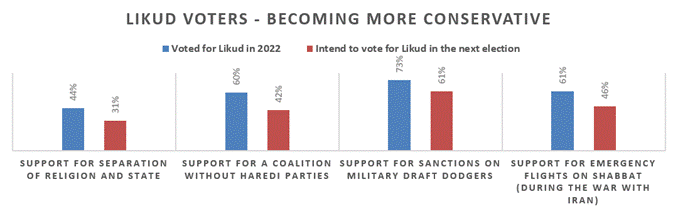
Similar trends emerge regarding a future coalition: 68% of the Jewish‑Israeli adult public supports a broad coalition without the ultra‑Orthodox parties—or including them but without granting their demands on religion‑and‑state matters such as draft exemptions for yeshiva students, increased funding for religious institutions, bans on public transport on Shabbat, preventing civil marriage, and non‑enforcement of the core curriculum. This view is shared by 60% of those who voted Likud in the last election, 39% of Religious Zionism and Otzma Yehudit voters, and over 90% of Yesh Atid, National Unity, and Labor‑Meretz voters.
73% of the public sees the tension between ultra‑Orthodox and secular Jews as one of the two most severe conflicts in Israeli society today—second only to the right–left divide.
When asked which religion‑and‑state issues matter most to them and which they want their preferred party to advance in the next election, the top priority is drafting yeshiva students into the IDF or national service (44%), followed by freedom of religion and equality in bearing the civic burden more generally (33%).
Impact of October 7 and the War
About half of respondents said their views on religion‑and‑state issues have not changed since the war began. 38% said the war strengthened their view that Israel must ensure an equal security burden, freedom of religion and freedom from religion, and that the Supreme Court must be able to protect these liberties. Only 13% said the war strengthened their view that Israel must protect the state’s Jewish character from Supreme Court intervention and increase state funding to reinforce Jewish identity.
During the war, instances of mixing religious beliefs with military functioning increased—for example, speeches by religious commanders depicting the enemy as fighting against God; and “Moshiach” patches (the emblem used by Chabad, which views the Lubavitcher Rebbe as the Messiah) affixed to uniforms, contrary to IDF regulations. According to the Index, 55% of the public opposes this phenomenon and says personal religious belief should be kept separate from the army.
During the war with Iran in July, the Transportation Minister accepted the Chief Rabbi’s directive not to allow rescue flights to Israel on Shabbat, leaving some 150,000 Israelis stranded abroad. According to the Index, 67% of those with an opinion said the minister should have allowed flights on Shabbat despite the Chief Rabbi’s position.
Here too, Likud supporters show a shift: among those who voted Likud in the last election, 61% said the minister should have allowed flights on Shabbat, whereas only 46% of those who now intend to vote Likud say so. Fully 96% of Bennett supporters said the minister erred.
Drafting Ultra‑Orthodox Men into the IDF
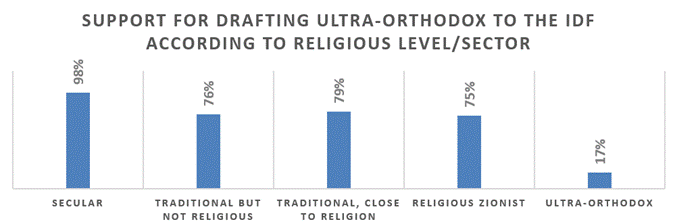
80% of the public supports drafting ultra‑Orthodox men into the IDF—either for a full‑length mandatory service or for essential national service according to the IDF’s needs (50%), or by setting an annual quota of exemptions for outstanding scholars and drafting all others to military or civilian service (30%).
The National Religious public plays a major role in the war effort—in both regular service and reserves—demonstrating that military service can be combined with a religious lifestyle. Unsurprisingly, support for drafting ultra‑Orthodox men is very high in this community (81%).
Just 20% of respondents said they accept the ultra‑Orthodox position that Torah study itself ensures Israel’s victory and benefits the state more than the army, and so Torah scholars should be exempt from service.
Support for drafting ultra‑Orthodox men includes 70% of those who intend to vote Likud, 84% of those who intend to vote Religious Zionism and 78% of those who intend to vote Otzma Yehudit.
Sanctions on Draft Evaders
The Supreme Court ordered the state to draft ultra‑Orthodox men and to halt funding for yeshiva students who refuse to enlist. Additional options under consideration include denying other benefits to draft refusers (e.g. municipal tax discounts and kindergarten subsidies), along with further measures such as revoking driver’s licenses and passports. According to the Index, 75% support all of these measures (59%) or some of them (16%), and only 25% oppose sanctions.
Among prospective Likud voters, 61% support sanctions—a drop of 12 percentage points from those who voted Likud in the last election. Among those who intend to vote Religious Zionism and Otzma Yehudit, support stands at 51% and 56%, respectively. Among Bennett supporters, 86% support sanctions to promote enlistment. Only 8% of respondents with an opinion believe that imprisonment alone would lead to a significant number (5,000 or more) of ultra‑Orthodox enlistments, compared with 26% who believe civil sanctions would do so and another 19% who say a combination of imprisonment and civil sanctions would work. By contrast, 47% think the ultra‑Orthodox will not enlist in large numbers even if sanctions are applied—up 10 points from last year’s Index—reflecting skepticism about the system’s ability to conscript them.
Prosecuting Rabbis Who Call to Violate Draft Laws
67% of the public believes the state should prosecute rabbis who call for violating draft laws—for example, former Chief Rabbi Yitzhak Yosef, who said that anyone receiving a draft order should tear it up. This represents a 14‑point increase from last year’s Index. Support includes 41% of religious respondents. Here, gaps within the National Religious community are pronounced: 78% of ‘liberal religious’ respondents support prosecution, compared to just 41% of those who identify as Torah‑oriented religious.
Education
73% of the public believes ultra‑Orthodox schools should be required to teach the core curriculum—like state schools—and to participate in external exams that verify compliance. Of these, 53% say institutions that refuse should be denied state funding, and 20% say their funding should be cut by 50%. Support includes 95% of the secular public and 57% of the religious public.
71% support including Jewish heritage content in state (non‑religious) education—provided the content reflects a pluralistic approach and presents students with the full spectrum of perspectives, including secular, Orthodox, and non‑Orthodox religious approaches. Support for this stands at 88% among the secular public and 55% among the religious public; among the non‑ultra‑Orthodox population as a whole, 79% support this approach. It should be noted that changing the character of heritage studies and aligning them with conservative and nationalist views is a flagship initiative of Education Minister Yoav Kisch.
Stanley P. Gold, Chair of Hiddush USA, said: “Hiddush was founded as an Israeli-Diaspora partnership, believing in the bond and shared responsibility of our communities, For many years, and especially spokespeople of Netanyahu’s governments, have claimed that their policies regarding the Jewish character of the State of Israel represent the democratic choice of the Israeli public. As the Index repeatedly demonstrates, there is nothing further from the truth. It’s high time that my colleagues in the leadership of the American Jewish community openly and assertively challenge Israeli representatives regarding religious freedom and pluralism, knowing that far from interfering with internal Israeli affairs they are rather aligning themselves and partnering with the overwhelming majority of Israeli Jews.”
Rabbi Uri Regev, CEO of Hiddush – For Religious Freedom and Equality, said: “The overwhelming majority of the Jewish public in Israel wants a normal, liberal country that recognizes every person’s basic right to live according to their beliefs. Many of those who don’t, including members of the current Israeli government, would like to establish a Torah-state rather than a Jewish and democratic one, so they viciously assault the Supreme Court in an attempt to suppress the independent judiciary. Our Index clearly shows that the public has more faith in the Supreme Court than in the Knesset or government. The time has come for a major correction: end State-Rabbinate control over Jewish affairs in Israel; allow free choice in marriage, kashrut, and burial; guarantee freedom of movement, including on Shabbat and festivals; and ensure an education system that reflects diverse views of Israeli and Jewish identity.”
Methodology
The Religion and State Index survey was conducted by the Rafi Smith Polling Institute by telephone on July 31–August 1, 2025. It is based on a sample of 800 men and women representing Israel’s Jewish adult population (age 18+), with an additional oversample of 100 respondents from the religious public. Margin of error: ±3.5%. Because the topics are internal Jewish matters, the survey was conducted among self‑identified Jews only, not among all Israeli citizens.
Additional Findings
- Freedom of marriage: 60% of the public supports recognizing all types of marriage in Israel, including civil, Reform, and Conservative.
- Utah marriages: 63% of the public is unaware of the option of ‘Utah marriages’—civil marriages conducted by the State of Utah via remote video (Zoom). Following a Hiddush legal petition, the Supreme Court ordered the Population and Immigration Authority to register these marriages in Israel on the same basis as other civil marriages performed abroad.
- If all options were available and equally recognized by law, only 53% of the Jewish public would choose Orthodox marriage; 14% would choose Conservative or Reform marriage; 11% would choose civil marriage abroad; 11% would choose “Utah marriage”; and 11% would choose to live together without formal marriage.
- Civil burial: 56% of the Jewish public is unaware that civil burial is available in Israel. 38% say they would prefer it when the time comes, including 69% of the secular public.
- Trust in institutions: Of the Supreme Court, the government, and the Knesset, the Supreme Court enjoys the highest level of strong trust (30%); only 14% express strong trust in the government and 12% in the Knesset. 15% express strong trust in the Chief Rabbinate. About half of the public (45%) does not express trust in any of these institutions.
About Hiddush
Hiddush – For Religious Freedom and Equality is a non-denominational, non-partisan Israel-Diaspora nonprofit dedicated to advancing religious freedom and equality, as envisioned in Israel’s Declaration of Independence. Founded in 2009, Hiddush mobilizes grassroots support, conducts research and polling, provides legal assistance to victims of religious discrimination, and advocates in the legal system, and with policymakers and the media. Hiddush works to strengthen Israel as both a democracy and a Jewish state, while fostering ties with world Jewry.
The Religion and State Index 2025 was made possible through a generous grant from the Stanley, Marion, Paul and Edward Bergman Foundation.