 Boulder Jewish News Arts, Culture, Events, Lifestyles, Holidays, Synagogues, Education



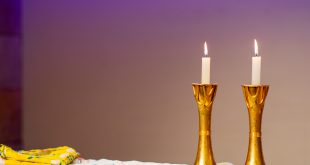
What makes Mikeitz so special? It always comes out the Shabbos of Hanukah! The Midrash oral commentary opens Mikeitz -meaning the end- with a strange associative verse: KEITZ SAHM L’CHOSHECH, -He placed an END to the darkness. One connection of the mystics is that the final seal of judgement for the New Year comes on Hanukah! The High Holidays focus more on our repentance whereas Hanukah is more about G-d’s grace. How appropriate that on Shabbos Hanukah, we kindle a combo of lights with both Shabbos and Hanukah candles. There are both practical and mystical aspects of this Friday night. Regarding the lighting laws – one should light the Hanukah menorah first, and for this particular night, the candles should burn for an extra-long time, enough to burn at least a half-hour past when the stars come out. For those using small candles on other nights, I find that tea lights are the most convenient. Then when the Shabbat candles are lit, there is a complementary glow both inside the home and facing the outside.
Let’s compare and contrast the two sets of lights. There is a brief reference to the Hanukah lights and that ‘happens’ to be in the tractate of Shabbos, in a section that mentions which materials are best suited for lighting. The key contrast is: ‘Oils that cannot be used for the Shabbat lights, are still acceptable for Hanukah.’ As we have mentioned previously, the mystics tell us that the Shabbat lights bring the Shechina, the Divine Presence, down to earth. This happens in the protective space of the home. The Hanukah candles on the other hand are meant to penetrate the ‘external world’. They can be lit with a blessing until, as the Talmud puts it, ‘the feet of the TARMUDA’I, the merchants (or rebels as another translation of the word, TARMUDA’I) have ‘left’ (or been transformed from) the market place.’ In short, Shabbos illuminates our homes internally, whereas Hanukah lights illuminate the darkness of the outer environment.

Indeed, when we have the two together as in the Shabbat of Hanukah, we have a profound connection to the primal light of creation. Originally this light allowed perception from one end of the world to the other; it was called the Ohr Ha’Ganuz, the hidden light. So where did this light go? Some opinions are that the light was hidden in the Torah, so that when a person truly internalizes multi levels of Torah, the light is accessed. Others say, the light can be perceived in the Shabbos lights, and others say, through the Hanukah lights. Perhaps all three are connected. Interestingly, the sages say that original light lasted for thirty-six hours – Friday, Friday night, and Shabbos day. It so happens that thirty-six is also the total amount of candles (not including the Shamash) lit throughout the eight days of Hanukah. And of course we know that thirty-six equals double ‘Chai’ – eighteen, the numerical equivalent of ‘life.’
Speaking of numbers, Shabbos is the seventh day of the week, whereas Hanukah is all about the number eight. Seven represents the cycle of nature and eight represents the ‘one step beyond’ phenomena of the miraculous. But these are not opposites; The Ramban teaches that the purpose of miracles is to remind us that all of nature is miraculous. Just as in any manifestation of light, we know that whether hidden or revealed, there is a source of the light, so too we have the Kabbalistic concept of continuous creation of something from nothing, ‘Yeish Mei’Ayin. Just as in Mikeitz we see that the life of Yosef is miraculous; he too literally went from the darkness of a pit, to the light of becoming the sustainer of his family and all of Egypt. This concept was antithetical to the Hellenistic belief that what is real is only what is tangible to the senses.
The Slonimer Rebbe explains that Shabbos Hanukah, as the intersection of two contrasting holy times, offers a unique opportunity. The lights of Shabbos usually uplift only those who have already elevated themselves, but on Shabbos Hanukah, the two lights work in tandem. The lights of Hanukah raises even the lowliest soul from the depths, enabling even the Shabbos light to raise him even higher. Thus at least once a year, every person can tap into the exalted sanctity of Shabbos. In short, on this special Shabbos Hanukah, we have the chance and the ability to transform any darkness in our homes and in the world and to reveal that hidden light which is really meant to illuminate the whole world, bringing back a Gan Eden state down from heaven, where the Shechina can once more walk with comfort and pleasure in this ‘Garden apartment’ right here on earth, among human beings who were created in the Divine image from the very beginning.
Chag Sameach!




Morah, your Torah is too deep for me to understand.